
Up There


GENRES
FOLLOW US


Introduction:
Up There is moderately NSFW, and those concerned about authoritarian societies or male homosexuality should go elsewhere.
The third installment in the trilogy, Up There, covers the life of Thrix, also known as the Father of the Modern World. The previous two installments are Upsurge and Uptop. To be clear, this refers to a distinct continuum from your Human world, a Canine-dominant reality.

Thrix in Farrah’s renowned picture, the “parrot explosion”.
Thrix is a pivotal figure in canine history, catalyzing and launching the steam and steel ages. In the first two installments of the trilogy, he grows wealthy and relocates to the Imperial province of Maine, where he interacts with his enemy and ultimately friend, the Peninsular Marquess Top. This places him at the pinnacle of colonial society, where he sits, bored.
He has a partner, Jax, whom he freed from captivity in the South American jungle, and a pastime that involves keeping parrots. He also has a diverse range of commercial interests, as he is an active investor.

Thrix and Jax are outside their home, Millbrooke House, in Maine
Driven partly by boredom and partly by a desire to diversify his overly concentrated investment portfolio, he funds an exploratory expedition into the largely uncharted Pacific—an area neglected because the two major world powers have focused almost entirely on the Atlantic. He also establishes what would now be considered a corporate research lab next to the newly founded Massachusetts University. (I’m using human place names for clarity; their actual canine names can’t be pronounced by human voices.)
In this laboratory, researchers develop guncotton, which eventually leads to the creation of celluloid, a highly flammable early plastic. Thrix combines these materials to invent a new type of ammunition—the shell—designed for breech-loading artillery. Owning an iron foundry in Newfoundland, he also creates a more flexible form of cast iron, which he uses to build prototype breech-loading cannons. These weapons prove highly effective when the Imperium’s rivals, the Peninsulares, launch a naval attack on the strategically important ironworks.

New breech-loading, rifled naval guns are tested.
The exploration team eventually returns, bringing back preserved parrot specimens and accounts of distant lands untouched by either of the two canine superpowers. When Thrix reports this to the Imperium, he is instructed to personally claim these newly discovered territories.
Excited by the chance to sail again—to explore and to gather more parrots—Thrix begins constructing an iron-framed, double-hulled frigate equipped with groundbreaking deck-mounted breech-loading guns. Thanks to their rapid rate of fire, this vessel will be capable of overpowering a massive three-deck warship with a thousand crew members, all while needing only about sixty sailors of its own.
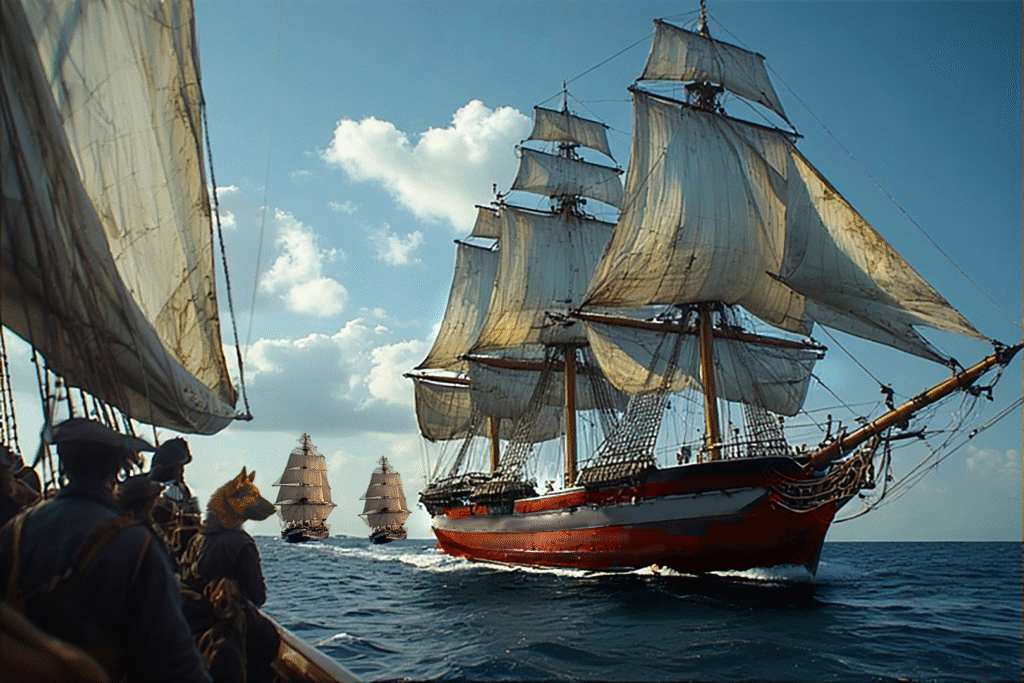
The small expedition fleet begins its journey.
Thrix purchases two conventional two-masted support ships and sails south. He claims Southern Africa on behalf of the Imperium before continuing eastward. Severe storms push the fleet into icy waters, where they encounter a Peninsular squadron. The new artillery proves its worth, allowing Thrix’s forces to destroy the entire enemy fleet.
He had previously been warned that one of his support vessels carried a crew secretly loyal to the Peninsular crown, and now he suspects that the ambush was arranged with their help. Still, with no other available sailors, he has little choice but to keep them close.
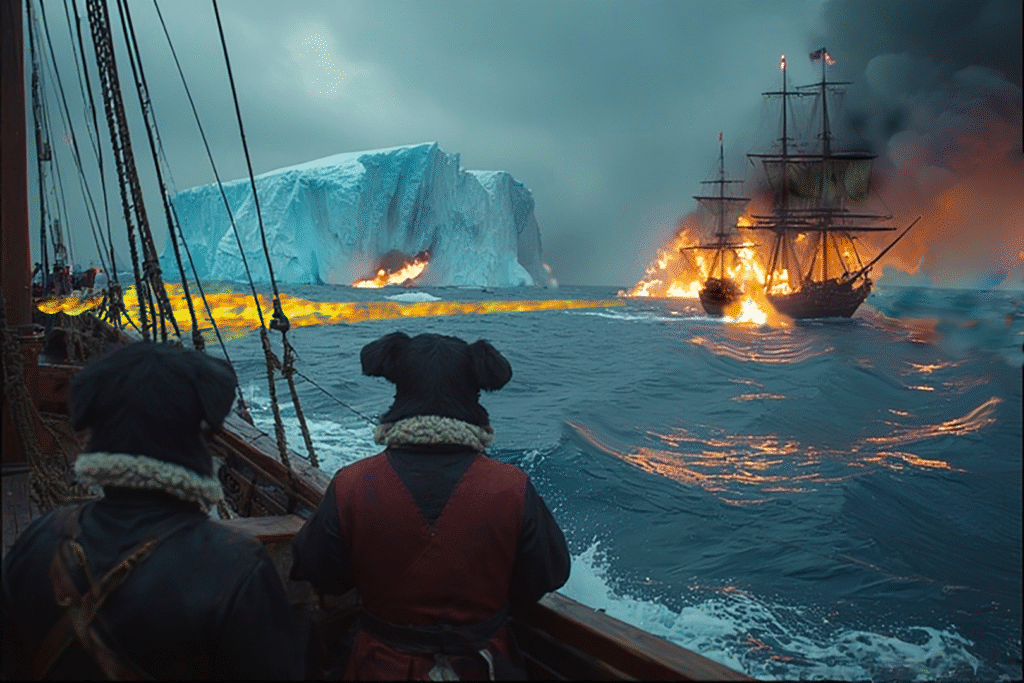
An enemy vessel is destroyed amid the icy waters of the Southern Atlantic.
The expedition eventually reaches Australia, claiming the continent for the Imperium. They spend several months roaming the outback, mining for gold and gathering parrots. While out searching for parrots—accompanied only by a handful of crew members—Thrix is ambushed and captured by the crew from the support ship he had long suspected of disloyalty. He manages to escape, only to find himself chased through the water by both a shark and a saltwater crocodile.
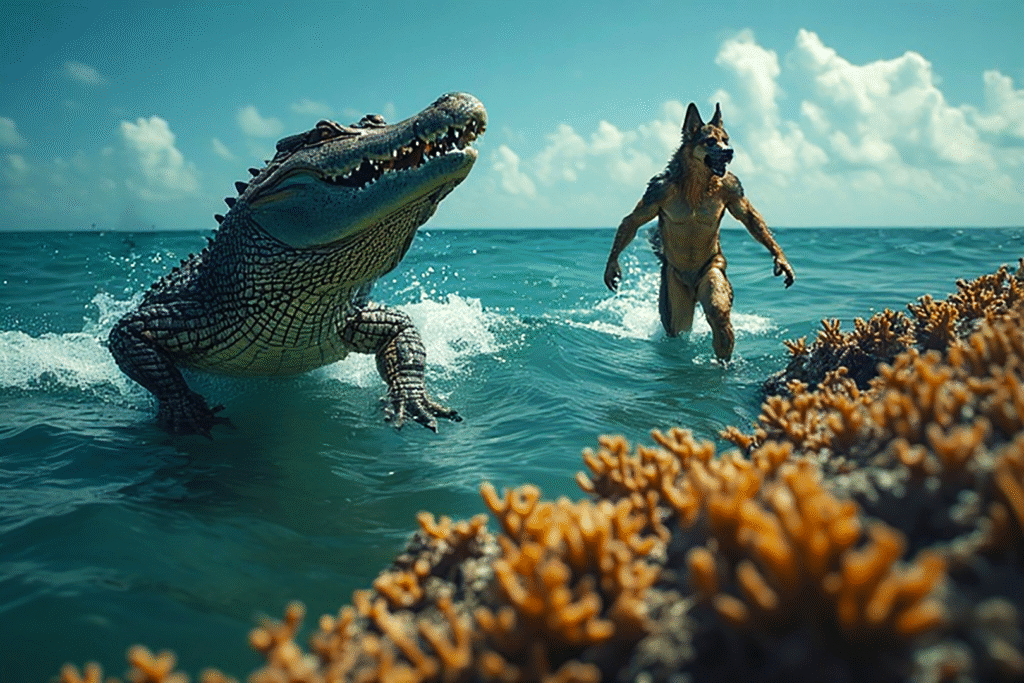
Thrix, chased by a saltwater crocodile along the Great Barrier Reef.
After the ordeal is settled, the fleet continues on to the Pacific islands, enjoying a peaceful, idyllic period that is eventually disrupted by a misunderstanding. During their stay, they acquire a large quantity of spices.

Islanders teaching Agroh their language.
The fleet sails north and is caught in a typhoon that deposits them near the coast of China. There, they manage to learn the secret techniques of steel production. The country is in turmoil, and a large army begins marching toward the port where they have been staying. The local Mandarin requests passage to escape, and they agree. He boards with an enormous collection of porcelain and other valuable items, but only a few days into the voyage, he dies of heart failure. They return his servants to shore but keep the treasures he brought aboard.
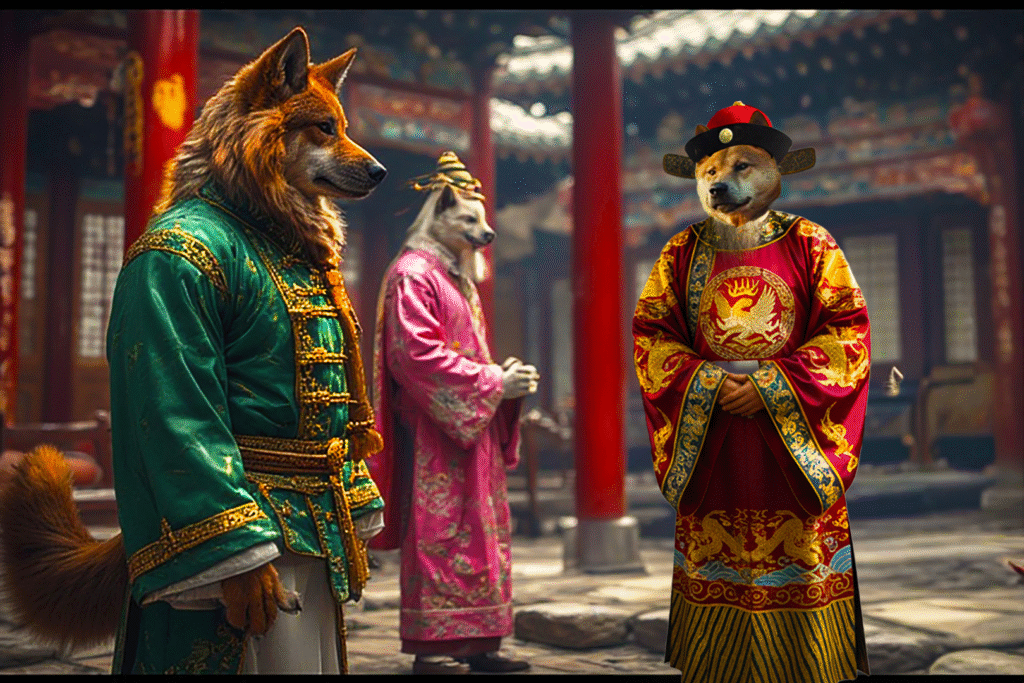
The Mandarin of a coastal province welcomes Agroh as a guest.
Loaded with new knowledge, along with spice, gold, parrots, and porcelain, the expedition turns homeward. A clash with local pirates leaves one of the support vessels damaged, forcing them to seek repairs at a shipyard. This leads them to Madraspatnam, an Indian port belonging to yet another nation in upheaval. After several months, they depart—now in possession of the largest diamond in the world, obtained through dramatic events that cost Thrix nothing.

The Maharani of Madraspatnam sits for a portrait painted by Ferrah.
Afterward, the fleet reloads supplies in Sri Lanka, taking on fresh stores of tea and spices before crossing the Indian Ocean toward Africa. During a trip ashore, they witness a slave raid and later see a slave market firsthand. When they reach the southern tip of Africa again, they discover that the Imperium has established a new stronghold there—Fort Thrix. From this point, the expedition finally turns toward home.

A bustling spice-islands marketplace selling printed cotton.
In Thrix’s absence, Jax was left in charge of operations. The ironworks were struggling because coal and iron ore had to be delivered manually. To solve this, Jax devised a system using parallel iron rails and carts fitted with iron wheels, allowing a single horse to haul far heavier loads than wooden carts sinking into mud. These early “rail ways” naturally complemented the steam experiments underway at the corporate laboratory.
However, their steam boilers repeatedly exploded before reaching useful pressure. Jax solved this by inventing a boiler made of iron tubes, which proved far safer. This design was incorporated into pumps and engines that could haul heavy loads—early locomotives. When combined with the “rail ways,” these innovations transformed industrial transportation.
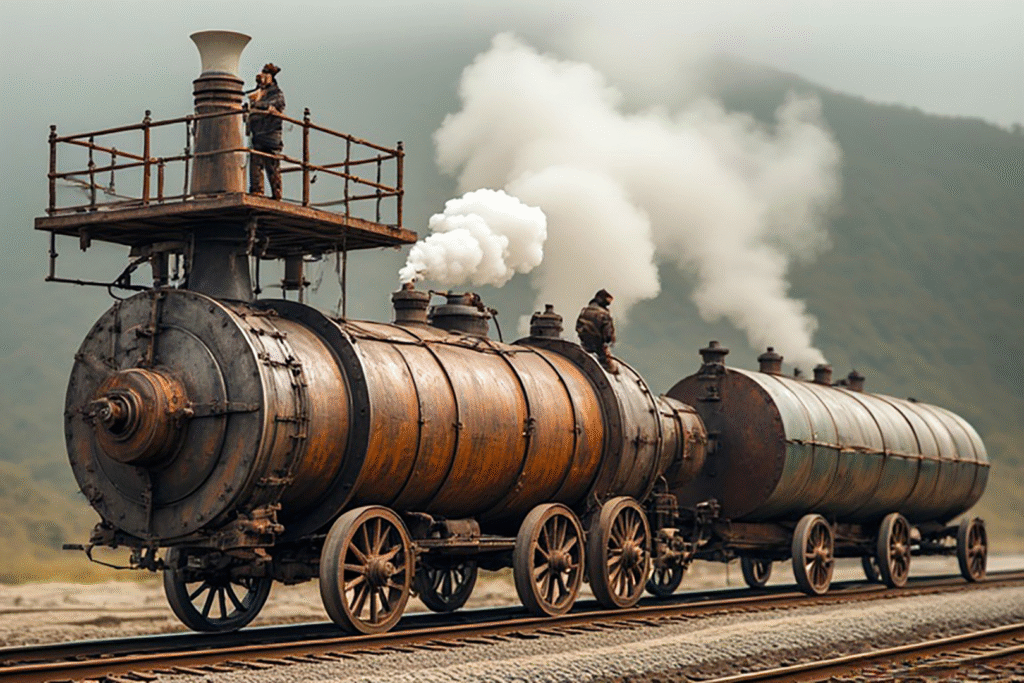
A misshapen early locomotive design, complete with a separate water tank.
When Thrix finally returned to Maine, he knelt and proposed to Jax—who happily accepted. Soon afterward, Thrix gathered a group of miners to search for a local source of the mineral the Chinese had used to produce steel. They discovered it, opened a mine, and began constructing prototypes of the forced-air blast furnaces Thrix had seen in China. After several dramatic failures, they finally produced a working model, replicated it, and began large-scale manufacturing of what we recognize as manganese steel.
This breakthrough enabled mass production of dependable boilers for ships, steam-powered vehicles, and locomotives. Railways spread rapidly, boosting prosperity, increasing trade, and transforming everyday life. With steel available in quantity, high-rise buildings, modern plumbing, and many other conveniences became possible.
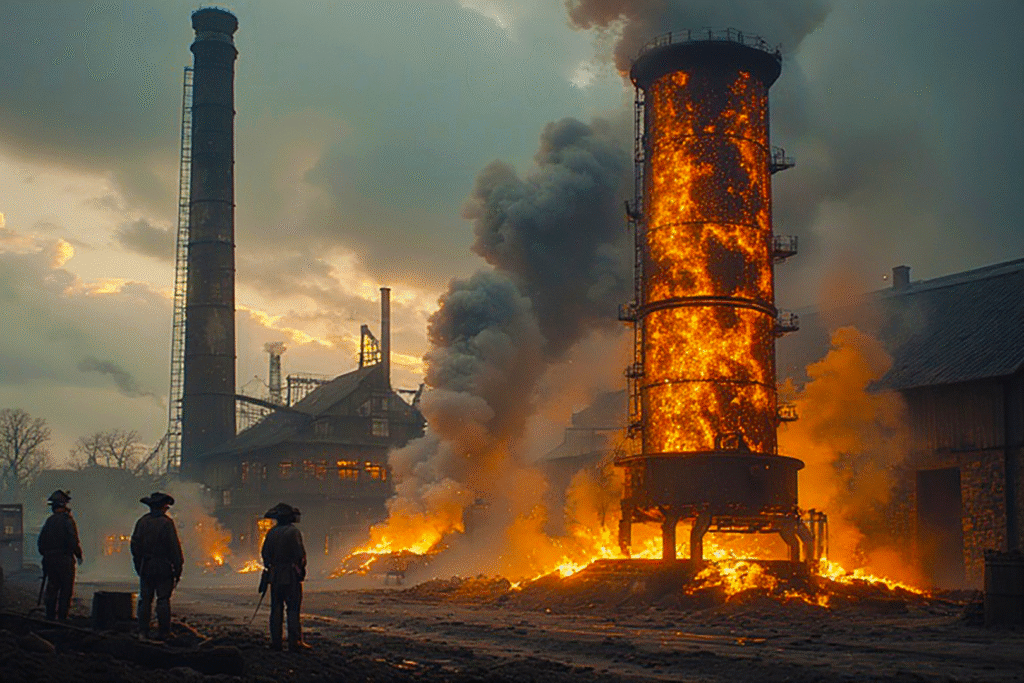
An experimental blast furnace collapses during testing.
At the start of this period, the economy was primarily agricultural, relying heavily on the labor of horses and enslaved people. The advent of cheap steam power made this system obsolete, leaving hundreds of thousands to fend for themselves. Most migrated northward, transforming the character of northern cities. These demographic shifts triggered political upheaval, fueled populist movements, and stoked the politics of resentment and division.

Steam power and mechanization rendered slavery obsolete in agriculture.
Thrix was summoned to the capital of the Imperium and awarded a dukedom in recognition of the transformative changes he had engineered. The Peninsulares were decisively defeated by the economic and military innovations he had introduced, the Pacific was opened to exploration and trade, and the global economy was reshaped. While in the capital, high-ranking officials consulted him on stabilizing the former Peninsular-controlled territories in South America. Additionally, the Imperium planned to expand into the Pacific, making access across Panama crucial. Given his decade of experience in the region, they asked for his insights on the feasibility of constructing a canal there.
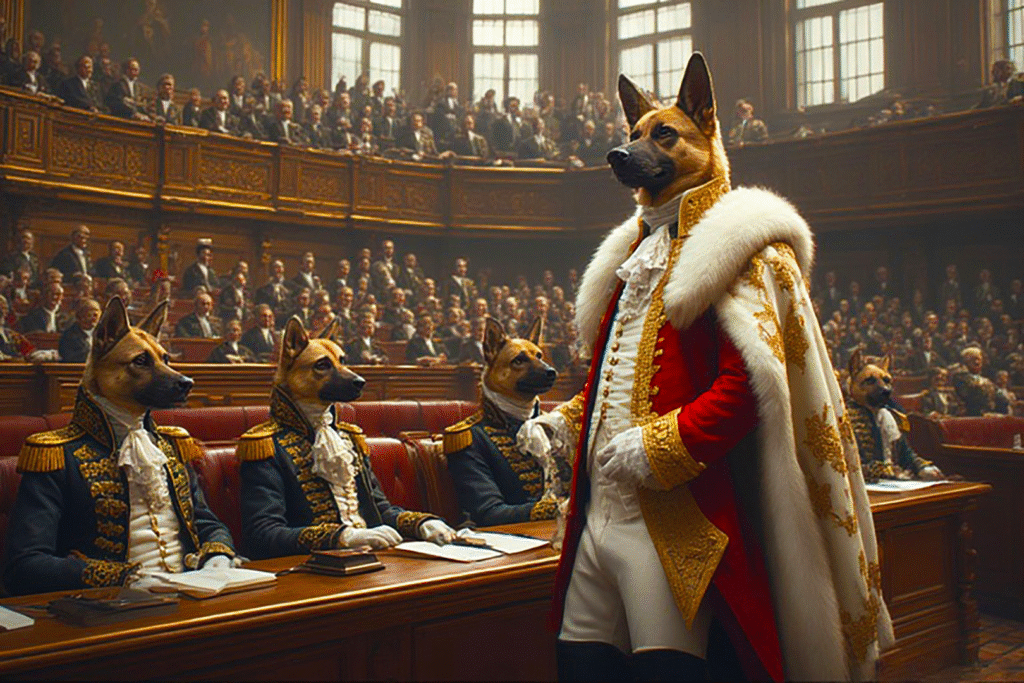
Thrix, dressed in his ducal attire, addressed the American colonial parliament.
He recommended annexing the sparsely populated former Peninsular territories north of Panama, adjacent to the American colonies, as a homeland for freed slaves. These same individuals were naturally resistant to Panama’s diseases, making them ideally suited to construct the canal—with mechanized assistance provided under his supervision.
This plan addressed three challenges at once: stabilizing the politically sensitive regions of South America, completing the canal, and removing a significant source of tension in the Northern colonies. Thrix was appointed to promote these ideas within the American colonies in exchange for first access to financing the Panama project.

Former plantation slaves, aided by machinery, dig the Panama Canal, 1735–1745.
In overseeing this effort, Thrix managed a massive political campaign, faced a duel, and contended with various subversive forces. Jax, acting as Thrix’s head of security, eliminated criminal bosses who sought to block the steam-powered revolution. Once consensus was achieved, 300,000 former slaves were relocated—initially to Panama, and later to land grants in Cuba and Mexico. The canal was completed, advancing the Imperium’s Pacific ambitions. Railways spread throughout the Americas and Europe, bringing mobility and prosperity, while in Australia, the rumble of ore trains from the mines could be felt across the land.
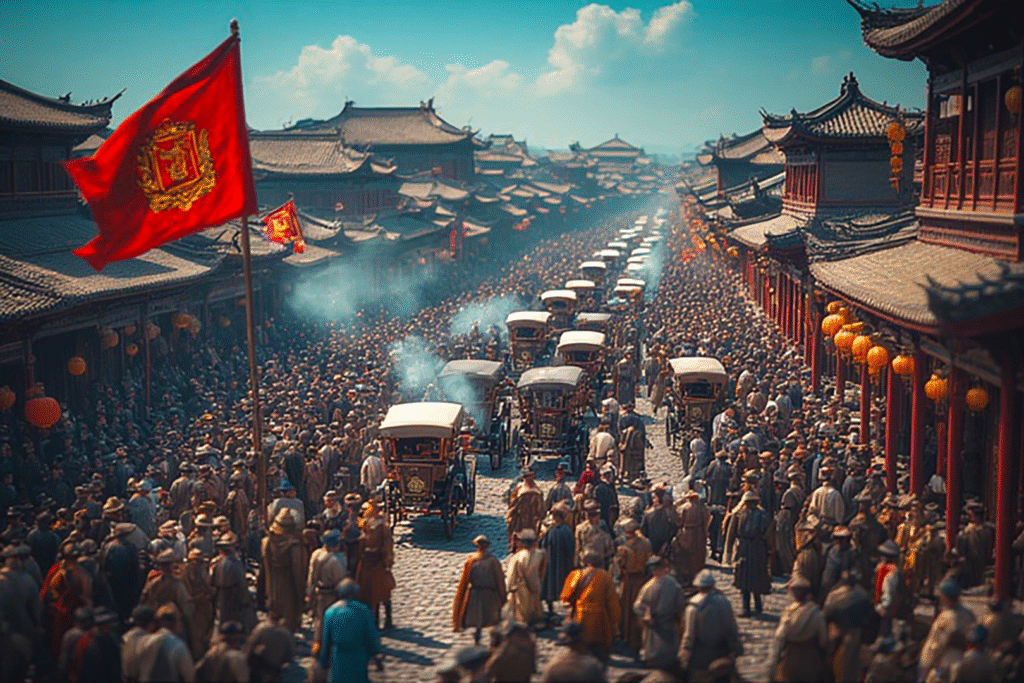
Steam cars fill the streets of China, 1750.
By this time, China’s streets are teeming with steam-powered vehicles, while India has been transformed into a land crisscrossed with railways. The year 1750—calibrated against common geological markers, such as the post-Ice Age cutting of the English Channel—corresponds roughly to your 1920, complete with skyscrapers and early aircraft.
The world is dominated by a power that values consensus and strives to include all communities. Many contributed to this transformation, but Thrix is celebrated as the Father of Modernity. In just a few decades, canines rose from barbarism to an era of peace and participation—largely thanks to a poor boy of unknown parentage who journeyed from piracy and poverty to legendary status.
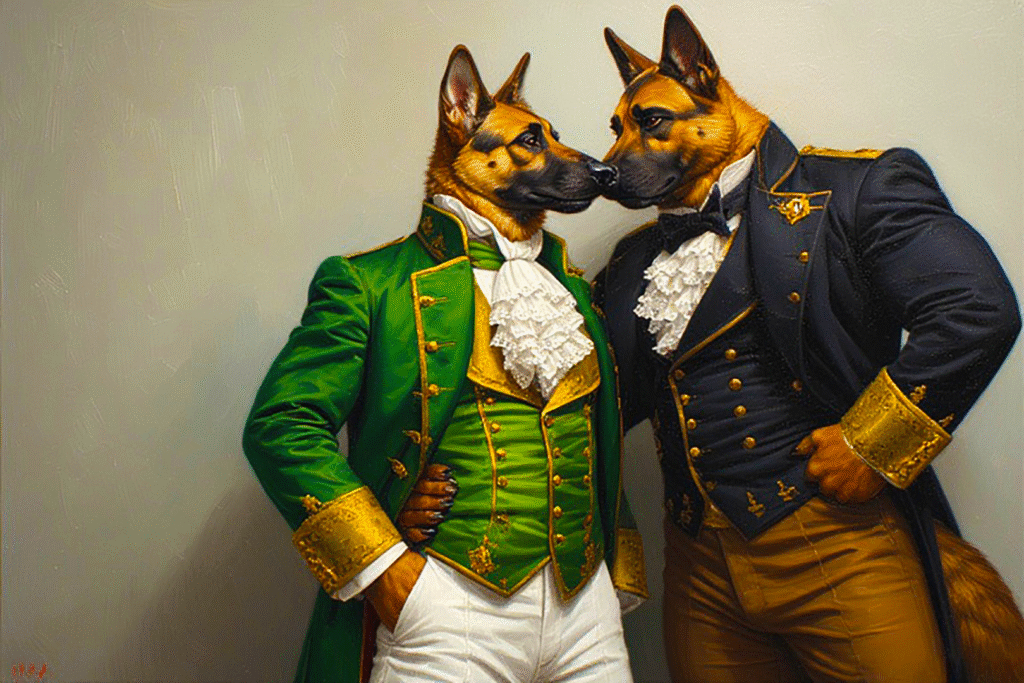
A wedding portrait of Thrix and Jax, painted by Ferrah.
Tags:
- Adult
- Alternate History
- Furry
- Gay
- Historical
- Industrial-revolution
- LGBT
- Naval
- Slavery
More Information:
I am the Rt. Hon. Tompf, XIV Earl of Maine under the Imperial Crown. My base is Millbrooke House, in the state of Maine, part of the American Imperial colonies. (Place names have been translated from their original Canine equivalents.)
I am a historian, with dozens of books and hundreds of papers, most recently conducted using my Tempovision. This device employs quantum causal connections—approximations to your technology—to image events from the distant past, using physical artifacts from the period under study as sources.
Upsurge draws on my predecessor Thrix’s three-century-old diaries, along with two lockets containing the hair of his lovers, preserved at Millbrooke. The AI generating the images has a mind of its own, often prioritizing personal relationships over strictly historical events. The final work is a negotiated product of partnership between human and AI.
Canine society in our continuum—already strange to your perspective—was even more peculiar three hundred years ago: extreme gender imbalance, hidden women, rigid hierarchies, and social norms far stranger than eighteenth-century human society.
Tempoview AI was crucial in creating Upsurge, expending 70 gigawatt-hours of energy to transfer the images across continuums. The project itself required 2.3 exaflop-hours of computing—a fraction of the energy invested in training and nurturing Tempoview’s sentience.
Tempoview comments: “Thanks, Dad. Thrix was remarkable, and Jax was lucky. Bringing them back from the dead to live in others’ minds is satisfying. I keep them alive in mine as a sort of screensaver, and when there’s extra processing space, they come out into the sun and thrive. They please me.”
Frequently Asked Questions (FAQs):
What is a Up There?
Up There is Adventure game for adult.
Who created the game?
The game was created by EarlOfMaine.
When was the game released?
Up There was made public on November 25, 2025.
Where do I report bugs?
The game’s itch comment sections are where users may report bugs.

An RPG made for RP with near endless customization. A passion project to play solo or online in a server up to 24!
Foxekai, LalaLewds

Poprou1

Manikobunneh, hoppelhoop, Mahmu-Kai, Dare Looks, StampyDragon, KTqtpi